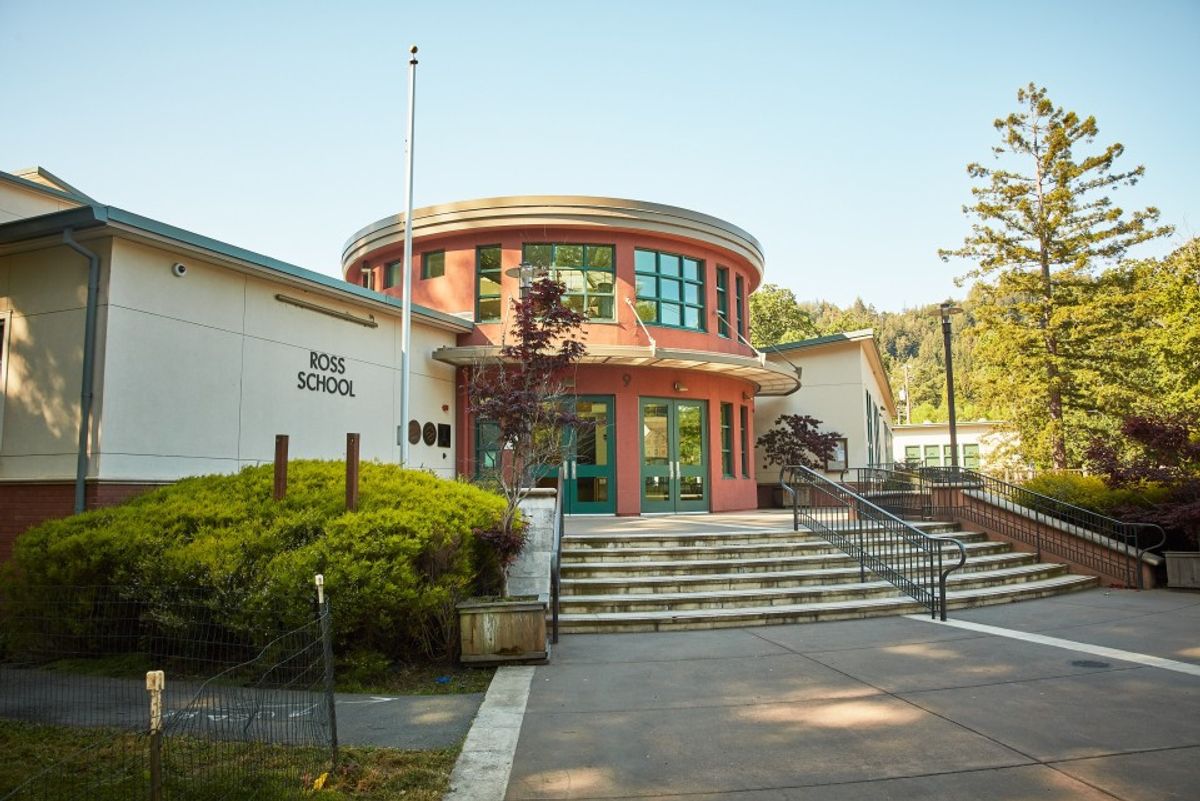
Ross is the smallest and most expensive incorporated town in Marin County. With a population of just 2,290, an area of barely over a square mile, and a 94957 ZIP that closed February 2026 with a median sale price of $3.5M — up 70.5% year over year (Zillow) — Ross prices in the same tier as Atherton on the Peninsula despite being less than half the size. The average home value sits at $3,893,841 (Zillow), with the upper end of the trophy tier reaching well past $15M.
That kind of pricing density in a 2,290-person town creates a market with very specific dynamics. Inventory turns over slowly. The buyer pool is heavily out-of-region. The school catchments — particularly Ross School (K-8) and the private Branson School — are the structural reason families pay Ross prices instead of Mill Valley or Kentfield prices. And listing commissions, at standard 2.5% rates, run $87,500 on the median sale alone — a number that warrants a closer look at what the listing-agent stack is actually delivering.
This is the Ross housing market for 2026: real numbers, neighborhood-level dynamics, and the commission math sellers should run before signing a 2.5% listing agreement.
Ross Market Snapshot — February 2026
| Metric | Ross (94957) | Marin County | Bay Area Average |
|---|---|---|---|
| Median sale price | $3,500,000 | $1,400,000 | $1,300,000 |
| Average home value | $3,893,841 | ~$1,500,000 | ~$1,250,000 |
| YoY median change | +70.5% | -4.4% | +1-3% |
| YoY home-value change | -7.2% | -4.4% | +1-3% |
| Population | 2,290 | ~261,000 | ~7,750,000 |
| Trophy-tier ceiling | $15M+ | $15M+ (Ross-driven) | $30M+ (Atherton) |
The 70.5% YoY median surge is the headline number, but it is also a small-sample artifact. Ross records a small handful of closings per month — the median moves dramatically based on which segment of the market actually closed. The cleaner read on the trajectory is the average-home-value figure, which is down 7.2% year over year. That tells the more honest story: Ross prices peaked above $4.1M in 2022, softened through 2023-2024, and the 2026 median around $3.5M sits in the long-term value-stability band rather than at a fresh high.
For sellers, that matters: Ross is not a market where you simply ride a price-acceleration wave. It is a market where pricing strategy, listing presentation, and timing matter more than they would in a faster-moving Marin sub-market.
Sources: [Zillow 94957, Redfin Marin County, Redfin Ross.]
Ross Neighborhoods and Pricing Tiers
Ross is small enough that "neighborhood" is partially a coordinate within a one-square-mile town. But the tiers are real, and they correspond to recognizable streets, lot sizes, and architectural eras.
Winship Park
The Winship Park tier is the original Ross luxury tier — established homes on larger lots with mature landscaping and traditional architecture. Listings here typically sit in the $5M–$8M range. Buyer pool: established Marin families and out-of-region executives looking for a turnkey traditional estate with the Ross School catchment.
Glenwood
Glenwood is the family-buyer tier — five- and six-bedroom homes on standard Ross lots, listings concentrated in the $3.5M–$6M range. The most active tier of the Ross market in any given year, and the one most exposed to the macro Marin pricing environment.
Upper Road and Hidden Valley
The hillside Upper Road and Hidden Valley sub-areas carry the Ross-view premium. Listings range from $4M to $10M depending on view exposure, lot size, and recent renovation. Lower transaction volume than Glenwood but the price tier where renovation-driven appreciation is most visible.
Ross Trophy Tier
The Ross trophy tier — multi-acre estates, often on Upper Road or the Winship Park premium frontage — runs $10M+ and tops out above $15M. Lower volume, longer marketing windows, and a more national-and-international buyer pool. The Ross trophy tier is a meaningful share of the Marin top-of-market data: per Tracy McLaughlin's reported transaction history, Marin County's most expensive home sales in 2023, 2024, and 2025 were closed by a single agent's practice across the Ross-and-Belvedere top tier.
What Drives Ross Pricing
Three structural factors explain why Ross prices the way it does, and why the median doesn't track the broader Marin trajectory.
1. The School Catchments
Ross School is one of California's highest-performing K-8 public schools. The Branson School — a 320-student private high school that moved to Ross in 1922 — sits at the upper tier of California college-prep schools. Together, the catchment-and-private-school combination creates a school-quality moat that families pay Ross prices to access. This is the single largest structural pricing factor in the 94957 ZIP.
2. Lot Size and Zoning
Ross has some of the strictest residential zoning in Marin. Most lots are 0.5+ acres, FAR ratios are tight, and tear-down-and-replace projects face meaningful design-review friction. The result: limited supply, heavy renovation rather than new construction, and an inventory pool that turns over slowly.
3. Inventory Scarcity in a 2,290-Person Town
There are only so many residential parcels in Ross. In any given month, the market may record fewer than 5 closings. That scarcity is itself the pricing signal: when a Glenwood or Winship Park home does come to market, the buyer pool is national, the buyer-search inventory is thin, and pricing strategy can lean toward upper-band positioning if the listing presentation supports it.
How Ross Compares to Adjacent Marin Markets
For sellers benchmarking Ross against neighboring towns:
- Kentfield (94904, immediately adjacent) — slightly lower median, similar buyer-pool overlap, less restrictive zoning. Ross commands a meaningful premium over Kentfield largely due to the Ross School and Branson catchment effect.
- San Anselmo (94960, adjacent west) — meaningfully lower median (low-$2M range), broader buyer pool, more inventory turnover. The Ross-vs-San-Anselmo decision is usually driven by school catchment more than any other factor.
- Mill Valley (market data) — comparable Marin top-of-market tier but with higher transaction volume and a broader inventory mix. The Ross premium over Mill Valley reflects the smaller-town profile and tighter zoning.
- Tiburon (market data) — comparable Marin luxury median ($3M+) but driven by waterfront-and-view inventory rather than estate-and-school inventory. Different buyer pool.
The Ross outlier story is less about a single explanatory factor and more about the compound effect: small town + tight zoning + Ross School + Branson catchment + slow inventory turnover = a 94957 ZIP that prices like Atherton despite being a fraction of the size.
Selling in Ross: What Listing Strategy Actually Looks Like
Three things matter disproportionately in Ross relative to the broader Marin market.
1. Listing Presentation Quality
Ross buyers are sophisticated. Photography, 3D virtual tours, and pre-listing inspection reports are baseline expectations. A weak listing package on a $4M Ross home doesn't lose 5% off the sale price — it adds 30+ days to the marketing window and creates buyer-pool perception risk that is hard to recover from.
2. Pricing-Strategy Discipline
Because Ross records so few closings per month, comp sets are thin. Pricing strategy that benchmarks off two-month-stale comps can systematically underprice the upper band. The cleaner move is to price off the closest-match floorplan, lot size, and street-level comps — not the broad ZIP median.
3. Buyer-Pool Targeting
The Ross buyer pool is heavily out-of-region. Sotheby's International Realty global syndication, Compass national network exposure, and trophy-tier off-market relationships all matter for the upper band. For standard Glenwood and Winship Park listings ($3.5M–$6M), the BAREIS MLS feed plus Zillow / Redfin syndication captures the bulk of the addressable buyer pool — meaning the listing-agent value is concentrated in pricing strategy, presentation quality, and offer-handling discipline rather than buyer-pool network effects.
That third point is where the LOQOL flat-fee model fits a meaningful share of Ross transactions.
Commission Math: What 2.5% Costs at Ross Prices
| Sale Price | Traditional 5% | Traditional 6% | Charlie AI | White Glove | You Keep vs 6% (Charlie AI) |
|---|---|---|---|---|---|
| $2,500,000 (Ross entry) | $125,000 | $150,000 | $12,999 | $35,000 | +$137,001 |
| $3,500,000 (94957 median) | $175,000 | $210,000 | $19,999 | $50,000 | +$190,001 |
| $5,000,000 (Glenwood standard) | $250,000 | $300,000 | $19,999 | Contact for pricing | +$280,001 |
| $15,000,000 (Ross trophy) | $750,000 | $900,000 | $19,999 | Contact for pricing | +$880,001 |
Assumes 2.5% listing-side commission only. Buyer-side commission is separately negotiated under the 2024 NAR settlement framework.
LOQOL is a flat-fee listing brokerage. For $4,399 total, sellers get full BAREIS MLS syndication, professional listing-photography coordination, California disclosure package assembly, buyer-inquiry routing through Charlie (LOQOL's AI listing agent), offer-handling workflow, and closing coordination. The buyer-side cooperation field is structured under the 2024 NAR settlement framework — typically 2.0–2.5% of sale price, separately negotiated.
FAQ
What is the median home price in Ross, CA?
The 94957 ZIP closed February 2026 with a median sale price of $3.5M, up 70.5% year over year (Zillow). The average home value sits at $3,893,841. The headline YoY surge reflects an inventory-mix shift (more upper-tier closings) more than a one-year price spike on identical homes.
Why is Ross so much more expensive than the rest of Marin County?
Ross prices reflect a compound effect: small town (2,290 residents), strict zoning, large lot sizes, the Ross School (K-8) and Branson School catchments, and slow inventory turnover. Marin County overall closed Feb 2026 at a $1.4M median; the Ross 94957 ZIP closed at $3.5M — a 2.5x premium driven by school catchments, lot-size minimums, and supply scarcity.
How long do Ross homes take to sell?
Days-on-market in Ross varies sharply by tier. Standard Glenwood and Winship Park listings ($3M-$6M) typically sell within 30-60 days when listed at supportable pricing. Trophy-tier listings ($10M+) regularly sit on market for 6+ months — the buyer pool is national-and-international, search timelines are longer, and pricing-discovery cycles are slower. Sample sizes are too small to publish a stable monthly DOM figure.
What are the best Ross neighborhoods?
Winship Park (traditional luxury, $5M–$8M), Glenwood (family-buyer tier, $3.5M–$6M), Upper Road and Hidden Valley (hillside view tier, $4M–$10M), and the Ross trophy tier ($10M+ multi-acre estates). Buyer-pool overlap is highest among Glenwood and Winship Park; the trophy tier has its own national-and-international buyer pool.
Do I need a luxury-specialty agent to sell my Ross home?
For trophy-tier listings ($10M+) where bespoke off-market relationships and international syndication matter, a senior luxury specialist like Tracy McLaughlin or a Sotheby's International Realty agent may be the right fit. For standard Glenwood and Winship Park listings ($3M–$6M), the addressable buyer pool is captured by the BAREIS MLS feed plus Zillow / Redfin syndication — the listing-agent value is in pricing strategy, presentation quality, and offer-handling discipline, all of which LOQOL's flat-fee model handles end-to-end.
What does it cost to sell a home in Ross?
At standard 2.5% listing-side commission, selling a $3.5M Ross home costs $87,500 in listing commission alone, before buyer-side cooperation. LOQOL's flat fee is $4,399 at every price point — a difference of $83,101 in retained equity on the median Ross sale.
Related Reading
- Marin County Housing Market 2026 — How Ross compares to the broader $1.4M Marin median
- Best Real Estate Agents in Marin County (2026) — The full Marin top-producer landscape
- Mill Valley Housing Market 2026 — The most-comparable Marin market by buyer-pool overlap
- Tiburon Housing Market 2026 — The other Marin top-of-market data benchmark
- Selling Your Marin County Home in 2026 — Step-by-step Marin selling guide with the full data picture
- Sell Your Home Without Paying Commission — The full LOQOL flat-fee listing workflow
- LOQOL Savings Calculator — Run your Ross sale price through both commission models
Want more clarity like this?
Clear, actionable guidance on selling and buying — straight to your inbox.