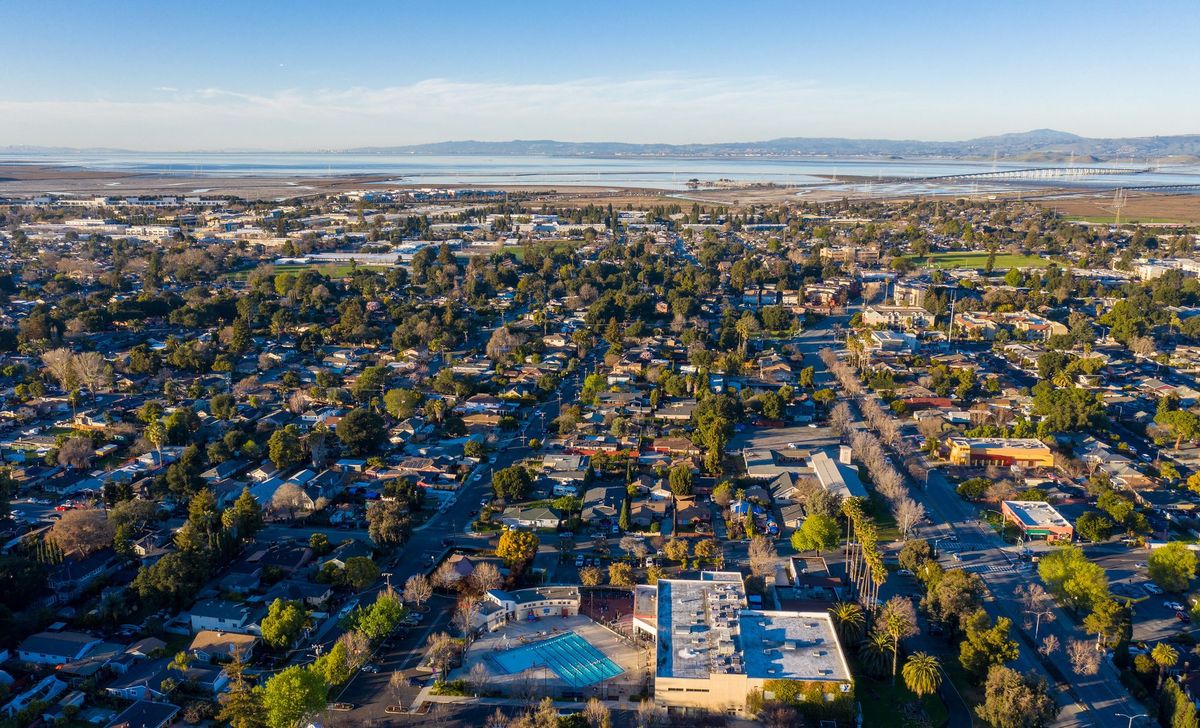
The East Palo Alto housing market in 2026 has a median sale price of about $1,130,000, up 4.1% year-over-year, with price per square foot near $808 (up ~20%). Inventory is tight and competitive — in the Weeks neighborhood, homes sell in about 10 days, often above asking (Redfin).
East Palo Alto closed early 2026 with a $1,130,000 median sale price (Redfin) — up 4.1% year-over-year — at a time when most of the East Bay and parts of the Peninsula were repricing flat or down. The headline number is impressive enough on its own, but the more interesting metric for sellers is price per square foot: at $808/sqft, up 20% YoY, East Palo Alto's per-foot pricing is appreciating faster than nearly any city in the Bay Area at this price tier.
That divergence between median price (+4.1%) and price-per-square-foot (+20%) tells a specific story: smaller East Palo Alto homes — the 1,000-1,400 sqft post-war ranches that dominate the Weeks and Woodland neighborhoods — are appreciating sharply, while the larger renovated homes are pulling the median average up at a slower rate. For sellers of the smaller stock, the 2026 market is materially more favorable than the citywide median suggests.
Neighborhood-level data backs this up. The Weeks neighborhood sees homes selling in about 10 days, average sale roughly 7% above list price, and hot homes selling about 14% above list in roughly 8 days (Redfin Weeks neighborhood). That's tighter than most of San Mateo County, faster than nearby Menlo Park (Menlo Park housing market), and on par with the most competitive Silicon Valley sub-markets.
This is the East Palo Alto housing market for 2026: a structurally tight, Meta-and-HP-anchored Peninsula market with sub-neighborhood dynamics that reward sellers who price into Weeks/Woodland micro-comps and a city-level relative-value position that makes it the cheapest "walking distance to Meta" address in the Bay Area.
East Palo Alto Market Snapshot — Early 2026
| Metric | East Palo Alto (Citywide) | Weeks (Premium Sub-Market) | Year-Over-Year Change |
|---|---|---|---|
| Median sale price (Redfin) | $1,130,000 | ~$1.1M list / 7% over typical sale | +4.1% (citywide) |
| Price per square foot | $808 | Higher on smaller stock | +20.0% (citywide) |
| Days to pending | ~14-15 | ~10 | Faster than 2024-2025 |
| Sale-to-list premium | Above list (typical) | ~7% above (14% on hot homes) | Most competitive tier |
| Median listing price | ~$1,060,000 | Tracks citywide closely | Recent listings inventory |
| Major employer adjacency | Meta / Tesla / HP minutes away | Meta direct shuttle range | Structural demand catalyst |
| 4 Corners development | Mixed-use downtown plan | Town-square anchor | Value-add catalyst |
Sources: Redfin East Palo Alto housing market, Redfin Weeks neighborhood, Redfin 4 Corners neighborhood, and Zillow East Palo Alto home values. Data reflects early 2026 reporting.
The headline: East Palo Alto is one of the few Bay Area sub-markets where price per square foot is up 20% YoY, where days-on-market is tightening rather than loosening, and where the structural employer adjacency (Meta, HP, Tesla, and the broader Stanford/Menlo Park research corridor) is reinforcing demand year over year rather than fading.
East Palo Alto Neighborhoods and Their Sub-Markets
East Palo Alto is small (~30,000 residents, ~2.6 square miles), but its neighborhoods have distinct pricing characteristics. The four main sub-markets:
Weeks — The premium sub-market for typical post-war single-family stock. Per Redfin's Weeks neighborhood data, the Weeks neighborhood is highly competitive, with homes selling in about 10 days, the average home selling for roughly 7% above list, and hot homes (top condition or pricing) selling in about 8 days at 14% above list. Weeks is generally west of University Avenue, with quick access to the Dumbarton Bridge corridor, and is the East Palo Alto neighborhood most aligned with Meta-shuttle and Stanford-area commute patterns.
Woodland — A central East Palo Alto neighborhood, typically smaller-lot, mid-century single-family stock. Pricing tends to track Weeks closely on per-square-foot basis but with slightly older inventory and tighter lots.
The Willows — One of the more historic East Palo Alto sub-areas, with a mix of single-family stock and some larger lots. Pricing varies more by individual property condition than neighborhood band.
4 Corners — The University Avenue / Bay Road intersection neighborhood. Per Redfin 4 Corners neighborhood data, this is the area where the city's mixed-use redevelopment vision is centered, with the "Four Corners" mixed-use downtown project anchored by a planned public town square and central plaza (Homes.com East Palo Alto local guide). For sellers near 4 Corners, the redevelopment plan adds a forward-looking value catalyst that's not yet fully reflected in current comps.
The pricing-strategy implication for East Palo Alto sellers: comp inside your sub-neighborhood and adjust for the square-foot reality. With per-foot pricing up 20% YoY but median price up only 4.1%, the comp data from 12-18 months ago materially understates current value for smaller homes. Use last-90-day sold comps, not 12-month-trailing data.
What's Actually Driving East Palo Alto's 2026 Demand
Meta, HP, and Tesla adjacency. East Palo Alto sits minutes from Meta's Menlo Park campuses, HP's Palo Alto headquarters area, and Tesla's regional facilities (Homes.com East Palo Alto local guide). For a tech worker priced out of Palo Alto ($2.85M+ median) or Menlo Park ($2.8M+ median), East Palo Alto offers the same commute at roughly 40% the median price. That structural relative-value position is the dominant 2026 demand driver.
Dumbarton Bridge access to the East Bay. East Palo Alto is the western anchor of the Dumbarton Bridge — a 15-minute drive to Fremont, Newark, and Union City, which broadens the buyer pool to include East Bay-based tech and engineering workers seeking Peninsula schools and Stanford-area amenities without Peninsula prices.
Per-square-foot appreciation outpacing median price. The 20% YoY rise in $/sqft (vs 4.1% median appreciation) shows that the market is bidding up the smaller, entry-level Peninsula stock specifically. Buyers willing to accept a 1,000-1,400 sqft home are paying premium per-foot pricing for the East Palo Alto address — a pattern that rewards sellers with smaller, well-maintained homes more than the median suggests.
4 Corners redevelopment. The mixed-use downtown plan at the University Avenue and Bay Road intersection is a long-term value catalyst. Walkable downtown amenities, town-square anchors, and density in the central commercial corridor add a forward-looking premium to nearby residential properties.
Stanford and the broader research corridor. Stanford University, the SLAC National Accelerator Laboratory, and the Stanford Research Park sit in adjacent Palo Alto and Menlo Park. Faculty, postdocs, and research staff who can't afford direct Palo Alto pricing increasingly look at East Palo Alto, particularly Weeks and Woodland, as a credible alternative.
Schools and Family-Buyer Dynamics
East Palo Alto is served primarily by the Ravenswood City School District (elementary/middle) and the Sequoia Union High School District (high school). Per GreatSchools East Palo Alto, the Ravenswood City School District has historically shown lower aggregate ratings than nearby Palo Alto Unified, and that's a real factor in family-buyer pricing — many East Palo Alto buyers are either pre-children, have placed children in private schools, or have selected charter or magnet options.
Sequoia Union High School District (covering Menlo-Atherton High School and other regional high schools) ranks more competitively. Several East Palo Alto attendance-zone homes route students to Menlo-Atherton, which is a meaningful price-supportive factor for those specific addresses.
For sellers, the school dynamic plays out two ways. First, family buyers will heavily price-discount blocks routed to the lowest-rated elementary schools, which can produce $50,000-$150,000 valuation gaps between two physically similar homes a few blocks apart. Second, the Meta/Tesla/HP-anchored buyer cohort is disproportionately pre-children or child-free, which means a large share of East Palo Alto demand is less school-sensitive than typical Peninsula markets. Knowing which buyer cohort your specific home will attract is part of the pricing math.
Selling an East Palo Alto Home in 2026: The Cost Math
At East Palo Alto's $1,130,000 median sale price, a traditional listing-side commission of 2.5%-3% costs the seller $28,250 to $33,900 — just to list. Add buyer's-side cooperating commission (still typically 2.5%, though increasingly negotiable post-Burnett), and the total commission cost on a median East Palo Alto home is $56,500-$62,150.
LOQOL's flat-fee listing model charges $4,399 to list and represent the seller — full MLS, full marketing, full transaction support — regardless of sale price.
| Sale Price | Traditional 5% | Traditional 6% | LOQOL Charlie AI | LOQOL White Glove | You Keep vs 6% (Charlie AI) |
|---|---|---|---|---|---|
| $900,000 (entry) | $45,000 | $54,000 | $4,399 | ~$13,000 | $49,601 |
| $1,130,000 (EPA median) | $56,500 | $67,800 | $7,999 | ~$16,000 | $59,801 |
| $1,500,000 | $75,000 | $90,000 | $7,999 | $22,000 | $82,001 |
| $1,900,000 (high band) | $95,000 | $114,000 | $7,999 | ~$28,000 | $106,001 |
The savings stack hard at East Palo Alto price points. The full-service traditional listing model removes ~3% of the home's sale price from the seller's pocket before the home even hits the title office; LOQOL's flat-fee model preserves that equity for the seller.
LOQOL's listing service uses [Charlie](https://loqol.ai/), the LOQOL AI agent, to drive routine listing operations — comparable-pricing analysis, MLS setup, marketing scheduling, showing coordination, and 24/7 buyer-question response — while licensed California real estate professionals handle disclosure compliance, offer negotiation, contingency timelines, and closing coordination. That's how the flat-fee math holds up at Peninsula price points without cutting corners on service.
How an East Palo Alto Seller Should Price in 2026
Three pricing-strategy takeaways for East Palo Alto sellers heading into a 2026 listing:
1. Comp on per-square-foot, not just total price. With $/sqft up 20% YoY and median price up 4.1%, the per-foot comp is the more accurate signal for smaller homes (<1,500 sqft). A 1,200 sqft Weeks home at $808/sqft prices to $969,600 — but in the most competitive Weeks micro-market, hot homes are clearing $1.1M+ on the same square footage. Use last-90-day sold comps within a quarter-mile, and adjust for the $/sqft trajectory.
2. Plan for a 10-15 day sale, but stage and price for the first weekend. Weeks neighborhood homes sell in about 10 days, with hot homes pending in 8. The first weekend's open-house traffic is the single highest-leverage marketing window. Photography, staging, and listing copy should be polished before going live — not adjusted after the fact.
3. Negotiate buyer's-side cooperating commission separately. Post-Burnett, buyer's agents increasingly come in with their own buyer-broker agreements. Many East Palo Alto buyers are tech professionals comfortable negotiating their own broker fees. Sellers reflexively offering 2.5% buyer's-side commission may be giving away $28,000+ that wasn't required by the market.
For deeper detail on pricing strategy, see LOQOL's pricing page and savings calculator.
East Palo Alto Housing Market 2026 — FAQ
What is the median home price in East Palo Alto, CA in 2026?
East Palo Alto's median sale price is $1,130,000 as of early 2026, up 4.1% year-over-year (Redfin). Median price per square foot is $808, up 20% YoY — meaning smaller homes are appreciating faster than the headline median suggests.
How long do homes take to sell in East Palo Alto?
East Palo Alto is competitive. Per Redfin's Weeks neighborhood data, Weeks-neighborhood homes sell in about 10 days, and hot homes pend in roughly 8 days. Citywide, days to pending typically run 14-15 days for typical inventory.
Which East Palo Alto neighborhood has the strongest appreciation?
Weeks is the most competitive sub-market, with average sales about 7% above list and hot homes selling about 14% above list in roughly 8 days. 4 Corners has long-term upside from the planned mixed-use downtown redevelopment.
Is East Palo Alto a good place to sell a home in 2026?
Yes. Price appreciation is positive (median +4.1%, $/sqft +20%), days-on-market is tight (~10 in Weeks), and the structural Meta/HP/Tesla adjacency continues to drive demand. Smaller homes (under 1,500 sqft) are appreciating fastest on a per-foot basis.
How much will I pay in commission to sell a home in East Palo Alto?
At the $1,130,000 median, a traditional 3% listing commission costs $33,900; a 2.5% commission is $28,250. LOQOL's flat-fee listing model charges $4,399 for the listing side — saving roughly $29,501 versus a 3% percentage model on the same sale.
What's the school district in East Palo Alto?
East Palo Alto is served by the Ravenswood City School District (elementary/middle) and the Sequoia Union High School District (high school). Some attendance-zone homes route students to Menlo-Atherton High School, which is a price-supportive factor. Per GreatSchools, school ratings vary by individual school — buyers typically check specific addresses before making offers.
How does East Palo Alto compare to Palo Alto for sellers?
East Palo Alto's $1.13M median is roughly 40% the price of Palo Alto's $2.85M median, while sitting minutes from the same Meta, HP, Tesla, and Stanford employers. For Peninsula buyers priced out of Palo Alto, East Palo Alto is the closest substitute — and that demand profile supports both East Palo Alto's 4.1% YoY price appreciation and its tight Weeks-neighborhood DOM.
Related Reading
- Menlo Park Housing Market 2026: Where Meta Money Meets $2.8M Medians and 12-Day Sales
- Redwood City Housing Market 2026
- LOQOL Pricing and Savings Calculator
- Sell Without Commission
- Best Real Estate Agents in East Palo Alto (2026) — $1.13M Homes, Weeks Neighborhood at 7% Over Ask in 10 Days, and the $33,900 Commission Question
Want more clarity like this?
Clear, actionable guidance on selling and buying — straight to your inbox.