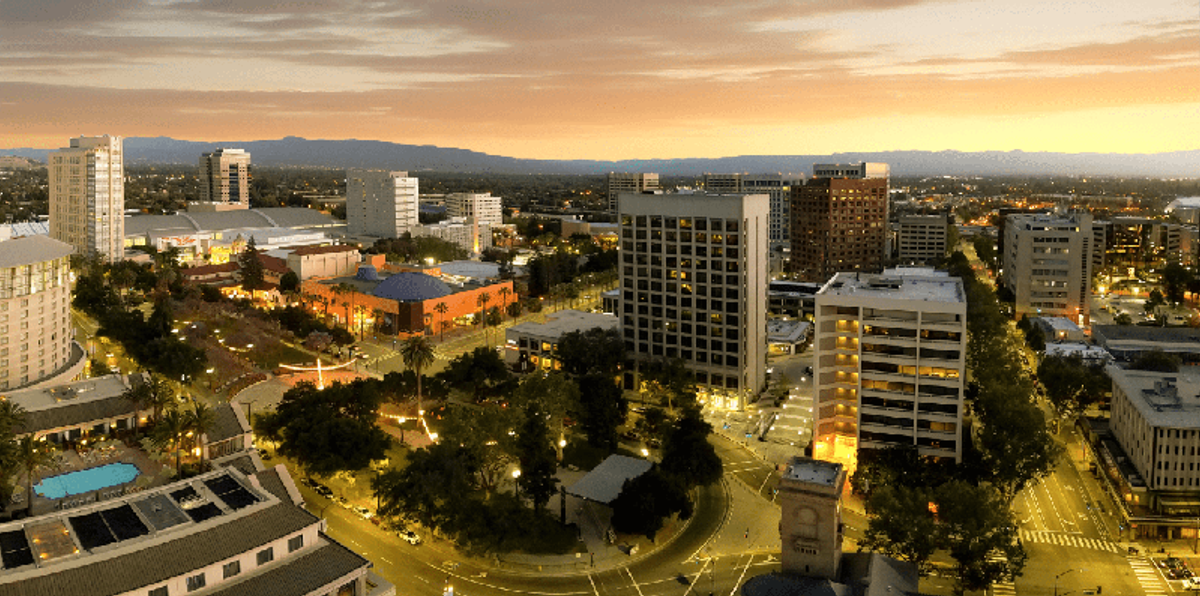
Santa Clara's 2026 market is compressed, fast, and almost entirely driven by one industry. Median sale price as of February 2026 is $1.8M, up 7.1% year-over-year. Homes receive about 3 offers on average and close in roughly 11 days. The sale-to-list ratio is 102.5%, meaning the typical seller clears 2.5% above list, and ~61% of homes sold above asking (down from about 70% the prior year, but still decidedly seller-side).
The "one industry" framing matters. Nvidia, Intel, AMD, Applied Materials, Oracle, and Ericsson headquarters sit within a three-mile radius of most of Santa Clara's owner-occupant housing. When those companies are hiring into on-site roles, buyer demand firms up. When they announce layoffs, Santa Clara showings soften within two or three weeks. No other Bay Area submarket — not Mountain View, not Sunnyvale, not Palo Alto — has this tight a linkage between a handful of publicly traded employers and its weekly buyer traffic.
This guide covers what the 2026 numbers actually mean by neighborhood, how school catchments divide the city's pricing, what the chip cycle is doing to comps, and the honest commission math at these sale prices.
The Numbers (Verified, April 2026)
| Metric | Value | Source |
|---|---|---|
| Median sale price (Feb 2026) | $1.8M | Redfin |
| YoY change | +7.1% | Redfin |
| Median days on market | ~11 days | Redfin |
| Offers per listing | ~3 on average | Redfin |
| Sale-to-list ratio | 102.5% | Houzeo (local MLS) |
| Homes sold above list | ~61% | Houzeo (local MLS) |
| Months of inventory (Feb 2026) | ~0.6 months | Houzeo (local MLS) |
| LOQOL flat listing fee | $4,399 | loqol.ai |
Sources: Redfin — Santa Clara Housing Market, Zillow — Santa Clara County Home Values.
Context: the broader Santa Clara County average home value was ~$1.57M (Zillow), down about 1.6% year-over-year. The city of Santa Clara is trading at a clear premium to county average — roughly 15% above county mean — because the city concentrates tech-employer-adjacent inventory in a way county numbers dilute.
Why the City Trades at a Premium to the County
Three reasons the city of Santa Clara clears higher prices than Santa Clara County's blended average:
- Proximity to the chip cluster. Nvidia HQ, Intel's Santa Clara campuses, AMD, Oracle, Applied Materials, and Ericsson are all inside the city limits or immediately adjacent. A hybrid engineer at any of these needs a 10-minute commute, not a 35-minute one. Willingness-to-pay for that compresses price-per-square-foot upward.
- Tight physical footprint. Santa Clara is 19 square miles with almost no raw land for new single-family development. Supply can't expand. It can only turn over.
- Compact elementary catchments. The "right" elementary is walkable — meaning every block-by-block comp is anchored to a specific school, not a vague district. Premiums for desirable catchments (Cupertino Union overlap zones, strong Santa Clara Unified elementaries) are baked into the price tape.
Neighborhood-by-Neighborhood Pricing
Santa Clara's 19 square miles split into distinct pockets. Pricing a listing off the $1.8M "city median" is almost always wrong — you want the closest same-pocket comps.
1. Rivermark (North Santa Clara, 95054)
Master-planned community built in the early 2000s. Single-family detached, townhomes, and condos, all clustered around a small village center. Rivermark buyers are almost entirely dual-income tech professionals who value the walkable pocket retail and newer construction. Detached single-family in Rivermark typically trades in the $2.0M–$2.5M range; townhomes $1.3M–$1.7M. This is the Santa Clara submarket closest to Intel, Marvell, and Great America, so demand rarely softens here first.
2. Santa Clara Square / Near Apple / Patrick Henry
The redeveloped apartment-heavy corridor near Bowers Avenue. Newer townhome stock, 2010s+ condo product, higher density. Good entry point for first-time buyers working at Apple, Nvidia, or Intel. Townhomes $1.1M–$1.5M, detached limited.
3. Old Quad / University (95050)
The historic heart of the city near Santa Clara University and downtown. 1920s–1940s bungalows on small lots, some rebuilt, some original. Detached typically $1.5M–$1.9M depending on condition. The pricing spread here is wider than anywhere else in Santa Clara — a fully remodeled 3/2 clears $2M easily; a deferred-maintenance original sits in the $1.3M range.
4. Cabrillo / Killarney Farms (95051, Central)
Prototypical postwar Santa Clara single-family — 1950s–1960s ranch homes, flat lots, the dominant Santa Clara Unified catchment. Most of the "median" headline is this inventory. Detached $1.7M–$2.0M; well-remodeled ranch homes clear $2.1M.
5. Sunnyvale West / Lick Mill / Bowers Park
The edges where Santa Clara bleeds into Sunnyvale and San Jose zip codes. Prices here depend more on which elementary catchment than on the Santa Clara label. Wide range, $1.4M–$2.2M.
| Neighborhood | Typical SFR Price Range | Dominant Buyer Profile |
|---|---|---|
| Rivermark (95054) | $2.0M–$2.5M | Dual-income tech / newer build |
| Santa Clara Square | $1.1M–$1.5M (TH/condo) | First-time tech buyers |
| Old Quad / University (95050) | $1.5M–$1.9M | Historic / walkable |
| Cabrillo / Killarney (95051) | $1.7M–$2.0M | Classic SCUSD catchment |
| Lick Mill / Bowers Park | $1.4M–$2.2M | Catchment-dependent |
Price ranges reflect observed 2026 MLS inventory and closed sales via Redfin Santa Clara and Zillow Santa Clara County. Your home's specific value depends on condition, lot, and catchment — see the section below.
School Catchments: The Single Biggest Lever You Don't Control
Santa Clara's pricing tape is more catchment-driven than most California cities:
- Santa Clara Unified covers most of the city. The highly-rated elementaries (Westwood Elementary, among others) command a premium. Buchser Middle and Santa Clara High are both well-rated, with Santa Clara High hosting the 49ers STEM Leadership Institute — a program visible in Santa Clara listing descriptions for a reason.
- Cupertino Union Elementary District overlap: a small portion of southwestern Santa Clara feeds Cupertino Union elementaries — a material premium, because Cupertino Union is one of the most demanded elementary districts in the Bay Area.
- Campbell Union Elementary overlap: a separate southern pocket. Slight discount to Santa Clara Unified mean.
If you're selling, the catchment is already priced in. If you're pricing a listing, do not pull comps from the wrong catchment — a two-block difference can move comp support by 10–15%. Confirm your home's elementary at GreatSchools before setting list price.
The Chip-Cycle Dynamic
Santa Clara's unusual vulnerability — and opportunity — is how tightly its weekly showings track the chip cluster's employment posture. This is not theoretical: you can see it in MLS data.
- When Nvidia and AMD report blowout quarters and expand on-site roles, Santa Clara showings-per-listing trend up within 10–14 days. Listings tighten DOM, increase offer count, and push sale-to-list past the 103% mark.
- When the same employers announce cuts or slow hiring, DOM drifts from ~11 days toward ~20 days within three weeks. Offer counts compress to 1–2. Sale-to-list ratios revert toward 100%.
This is not a reason to time the market to quarters — retail sellers can't. But it is a reason to check the macro tech news before signing a listing agreement and choosing list-price strategy. A 3-week-delayed listing into a clear rally is often worth more than a rushed listing into a soft week.
Commission Math at Santa Clara Prices
At $1.8M, every percentage point of listing commission is $18,000. Sellers almost never run this math at list-price signing. Here it is:
| Scenario | Listing-Side | Buyer-Side (Typical) | Total Commission |
|---|---|---|---|
| Full 2.5% + 2.5% | $45,000 | $45,000 | $90,000 |
| Negotiated 2% + 2.5% | $36,000 | $45,000 | $81,000 |
| LOQOL flat $4,399 + 2.5% co-op | $4,399 | $45,000 | $49,399 |
The listing-side difference between a traditional 2.5% commission and LOQOL's flat $4,399 on an $1.8M Santa Clara sale is $40,601. Model your specific price on the LOQOL savings calculator.
What This Means for Santa Clara Sellers in 2026
- Price to neighborhood and catchment, not city. A $2.0M Rivermark comp and a $1.7M Cabrillo comp both clear the $1.8M city median. They are not interchangeable.
- Expect 3 offers and ~11 DOM if priced correctly. The tight inventory (~0.6 months) does a lot of the work. Overpricing kills this — a listing that sits past 14 days starts to read as damaged to buyer agents in Santa Clara.
- Watch the chip news the week you go live. A visibly bad earnings report in Santa Clara's tech employer base softens buyer traffic faster than anywhere else in the Bay.
- Run the commission math up front. On a $1.8M sale, listing-side commission at 2.5% is $45,000. A flat fee of $4,399 keeps the vast majority of that in seller equity. See the full listing workflow at Sell Without Commission.
- Offer a competitive buyer-side co-op. Post-NAR settlement, buyer-side co-op is negotiated, but in Santa Clara buyer agents expect 2–2.5%. Undercutting it materially affects showing traffic.
Charlie and the Flat-Fee Option
Charlie is LOQOL's AI listing agent — a licensed California-broker-backed workflow that handles MLS listing, disclosure drafting, syndication to Zillow/Redfin/Realtor.com, offer coordination, and buyer-agent negotiation, all for a flat $4,399 listing-side fee. For Santa Clara sellers, the economics are straightforward: the same MLSListings exposure Compass and Intero use, the same disclosure rigor, the same signed California broker of record, for a flat fee instead of a percentage.
See LOQOL pricing for the full breakdown.
Related Reading
- Sunnyvale Housing Market 2026
- Cupertino Housing Market 2026
- Mountain View Housing Market 2026
- Flat Fee vs Commission: What California Sellers Actually Pay in 2026
FAQ
Q: What is the median home price in Santa Clara, CA in 2026?
The median sale price in the city of Santa Clara was $1.8M in February 2026, up 7.1% year-over-year per Redfin. Santa Clara County's blended average home value is ~$1.57M per Zillow. The city is trading roughly 15% above county average.
Q: Is Santa Clara a seller's market?
Yes. As of early 2026, Santa Clara shows ~0.6 months of inventory, a 102.5% sale-to-list ratio, and ~61% of homes selling above asking. Those three metrics together define a seller's market.
Q: How long does a home take to sell in Santa Clara?
Median days on market is approximately 11 days in early 2026. Well-priced, well-presented homes frequently go pending in under a week. Overpriced listings cross the 14-day mark and then require a price reduction.
Q: Which Santa Clara neighborhood is most expensive?
Rivermark (95054) is typically the most expensive owner-occupant neighborhood, with detached single-family in the $2.0M–$2.5M range. The Cupertino Union elementary overlap pocket in southwestern Santa Clara also trades at a premium driven by school catchment.
Q: Which Santa Clara neighborhood is most affordable?
Townhome and condo stock in Santa Clara Square and the El Camino corridor typically offers the lowest entry price, with townhomes commonly in the $1.1M–$1.5M range.
Q: How do chip-industry employers affect Santa Clara home prices?
Nvidia, Intel, AMD, Applied Materials, Oracle, and Ericsson headquarters are within a three-mile radius of most Santa Clara owner-occupant housing. Weekly showing traffic tracks those employers' hiring posture with a 2–3 week lag. When chip hiring firms up, Santa Clara DOM shortens and sale-to-list ratios rise; when it softens, DOM lengthens and offer counts compress.
Q: How much commission will I pay selling a home in Santa Clara?
Traditional full-service commission is typically 2.5% listing + 2.5% buyer-side = $90,000 on the city's $1.8M median. A flat-fee brokerage like LOQOL charges $4,399 listing-side, with the buyer-side co-op (typically 2–2.5%) negotiated directly — a total closer to $49,399 on the same $1.8M sale. Run your own numbers at the savings calculator.
Want more clarity like this?
Clear, actionable guidance on selling and buying — straight to your inbox.